28 July, 2006

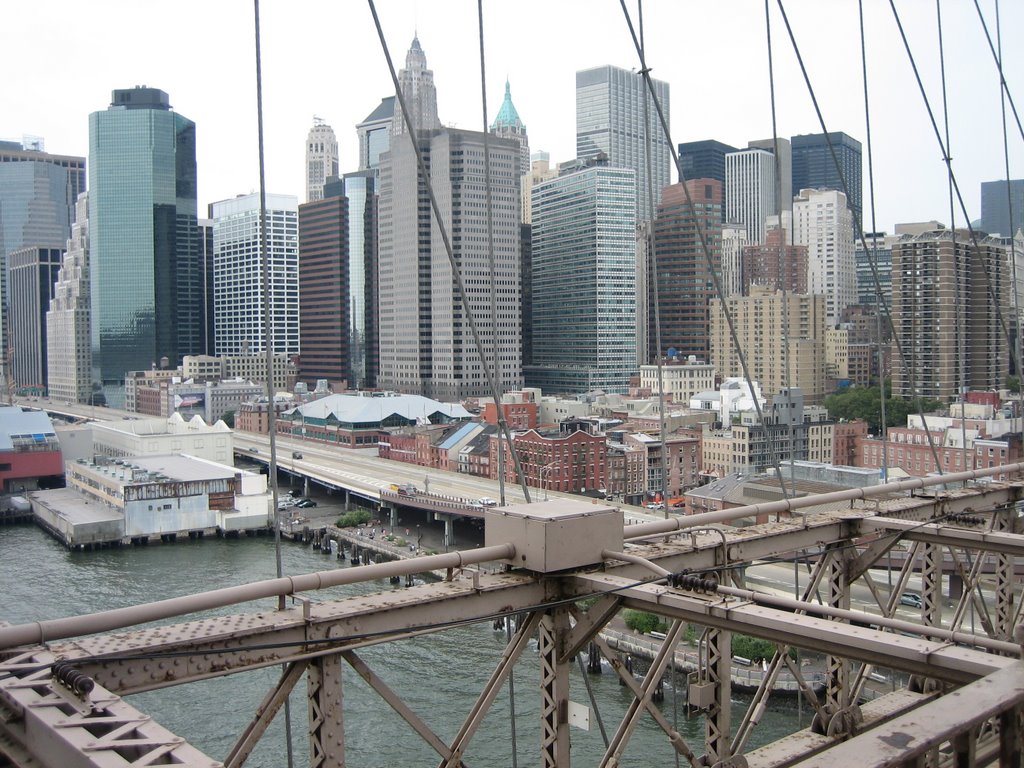
Karen on the Brooklyn Bridge


Karen Beth Hunter took this picture in July of 2005. She stopped for a moment as she rode her bicycle over that bridge in order to do so.

(This entry is still a work in progress, but it feels right to publish it, even as I work on it, if only for the picture. The elegy I wrote in Karen's honor, "Cardinal n30491 requesting clearance for takeoff" is one of the first entries on the blog. I wrote it in March, 2006.)


---Almost every day for most of the months of July and August, Karen rode her bicycle across the Brooklyn Bridge into Manhattan. Serendipitously, the very first artwork her parents bought together was a sketch of the bridge, which hung in her den/dining room. Most of the time, actually, we ate on the deck of her apartment which had a view of that bridge and of the city. We caught about 80 percent of the fireworks on the fourth of July and invited about thirty people over to share the event.

---She took a small, digital camera with her when she rode, though most of her work had been done on a traditional camera which she treasured. The digital camera was smaller and lighter, by far and she still managed to take beautiful shots. She was wrong – she wasn’t a craftsperson, but a true artist. She could see like no one I had ever known and she saw in huge frames. She’d become fascinated, in fact, with huge pictures. She took several of the water on the beaches of the Bahamas. We had wanted to develop one in poster-size and hang it on the wall of the bedroom, but we didn’t get to do it. Again, serendipitously, she saw a street-side exhibit of photographs with that idea in mind in Soho. She took me to it, shortly after and insisted we hold hands like friends do as we walked. Feeling a little jealous, I don't think I was as generous as I could've been with what was actually a terrific idea--holding hands. Enjoying simple touch and affection as we walked.

(A little before July 4th 2004, I put out an ad on Craig’s list titled, “Lost in Space”. I was only looking for a friend – someone willing to go on small adventures in the city with me. My closest friend had been ill for some time and could no longer leave her home often. Another has a child who has become the vortex of her life. And I could not keep up with the third of the group, whose salary was much larger than mine. Within about twenty minutes of posting the ad, I got a response from “Annon” who claimed to be willing to meet even though this probably would be akin to the “blind leading the blind”. She had just left a terrible relationship, one feature of which, I found out later, was that it had isolated her from anyone but her partner’s friends and family. My initial response was to correct the spelling of “anonymous” and ask for the name of this still unidentified person. She quickly apologized for being so out of touch with things as to not know when it was appropriate to give one’s name. And she appreciated the correction. She told me later that she liked my snappishness. She was a good writer and she loved words.

The emails lead to a meeting which included a long conversation in the rain after a visit to the Brancusi exhibit at the Guggenheim (where she claimed that her photography was craft, not art). It rained our next meeting, too. Before long, rain or not, we were always talking with each other. She was extraordinary and it was she who acknowledged that there was an attraction between us. But, my adolescence always precedes me and I was never enough in my own body to be a full partner. I was/am afraid to be more than an idea, perhaps a sketch -- like many of my generation, I'm good at impressions.) We were always the closest of friends, regardless, and, except for time at work, and small vacations she took without me, we were almost always together. Oddly, we drove over the bridge many times, but I never biked it with her. Being as heavy as I am broke, I could never ride a bicycle which actually moved anywhere and did not adjust with me as I lost my breath. )

---The evening of Sept. 11, 2001, Karen walked across the bridge alone with her now-ex partner. A psychologist, she had gone down to counsel people and allowed her partner as an "assistant" though she could not really do anything except stand away while Karen worked. The two walked in silence over the Brooklyn Bridge on their way home.

---Karen loved that bridge and she loved Brooklyn where she had built the greater part of her practice and where she could find all sorts of good food, and finally, an apartment with a view of the city, in the urban paradise Down Under the Manhattan Bridge Overpass. Dumbo, as it is known, also came with its own central, lesbian restaurant which features live country and folk music, which she also loved.

---Karen would walk her bike home with me from the gym or her office. I tried to ride it once, but it was too tall. I found that very odd because Karen wasn’t more than an inch or so taller than I am. Perhaps my problem also lay in the fact that I remember my training wheels fondly. She beat me home even when I took a cab or train. Home being her home. She never quibbled, however – it was our home because it was a home which she felt comfortable sharing and was the natural extension of the community she created just in knowing you. Having company -- being together as simply as in a playdate was essential to her. She often said she wished she had a partner who always brought people over so that even when she wanted to sit alone and read there would be people nearby. I trusted her completely, as I suspect her patients did because it was the natural response to her presence. I know she could be nervous, over-excited and Tigger-like in impatience. But, she was incredibly easy to be with, to tell your heart to, as it were.

---Being on a bridge is much like being in a plane in that you are suspended. I liked being in the air with her and I liked that feeling of nesting in mid-air between places and above the ocean. For Karen, I think, in the Brooklyn Bridge, there was also the promise of the enchanted urban carnivals on one side and the quiet on the other. Dumbo is immensely quiet though it looks onto so much activity.

---The bike path to the Brooklyn bridge is a long one and it swings around parks and traffic. Yet, once on the bridge, I imagine there is just that feeling of suspension. The sound of your own traveling. Of "being in the wind," which Karen once said she enjoyed.



The Dobbs is on TRUTHOUT!

Get out of town! There's an article by Lou Dobbs on Truthout.org. I guess he misses Randi Rhodes...AND HE SHOULD. Next Jack Cafferty on Truthout.org as he has already come around. Then Chris Matthews, then Wolf Blitzer...maybe they'll all shout, "I'm mad as hell and I am not going to take it anymore!"

Among the points The Dobbs makes is that the NAFTA treaty is not ratified. Did you know that? Does your union know that?

http://www.truthout.org/docs_2006/072706D.shtml

27 July, 2006

Israeli Outrage

Just wanted to spread the word that many Israeli's are protesting their government's actions. For an article on the most recent rally (I think), go to
http://www.commondreams.org/headlines06/0724-05.htm

Insuperable

The internet is loaded with progressive information and spirit. So, here we are "reaching out" to each other, emailing our congresspersons and never leaving our homes. Is it necessary for us to leave to make a difference? Can we change the world from our laptops?

I'm not being critical. All of this communication cannot be bad or all bad. I just feel suddenly like a kid whose parents said, "I'll think about it." Or like a student whose been told, "Keep up the good work." I'm encouraged with no real courage of my own, which is my fault. I'm in an insuperable depression and my fur-kids, Henry and Larry are trying their best to get me out of it.

26 July, 2006

Urgent reading

In addition to going to the Randi Rhodes show site, doing all the homework and looking especially at all the information on "Clean Break" please read Dennis Kucinich's "Prayer for America"
http://www.kucinich.us/speeches/20020217_prayer_for_america.php

25 July, 2006

Burning Habits and why theater is still worthwhile

I just came back from watching Blair Fell's play Burning Habits which is performed in several episodes at Dillon's bar in NYC. Just when I was feeling as if it is irresponsible to create art at a time when so much inequity exists at basic levels, the play reminded me of how important theater really is to our culture. Onstage, all of the revelations I consider so novel are taken for granted -- The Catholic Church, the homeless, gay bars, deaf mutes and musical theater all collide -- and, of course they do. Last year, when (my) Karen and I saw it, we were astonished by the wisdom spoken offhandedly between the jokes and the high campyness. There was one line which I can only paraphrase, which basically stated that, at a time when things are so wrong, one's only choice is to be an outlaw. The clarity the piece brings to the undercurrents of power and torture in our schools, our families and our struggling cities is incredible. And of course, it's incredibly funny. Where else will you see the ghosts of lesbian nuns, a southern housewife and rich ladies who are the true archetype for Karen on "Will and Grace" (not my Karen, the television Karen).


Sadly, Burning Habits closed. For information on when the show might re-open, and to join the mailing list go to: www.burninghabits.com

22 July, 2006

Starbucks-crossed cultures

Photo by Karen B. Hunter, August 2005.

For the past two nights, I have had someone get ahead of me in line. Before that, someone splashed a Passion Fruit tea --

400,000 people have been displaced in Lebanon and I'm about to describe a store full of twenty and thirty somethings who pause to find out what flavor of tea was splashed onto a homeless woman who wandered into the Starbucks at Union Square. Actually, I mean to prove that the two events are not so far apart. I do not pretend that I have experienced anything like the horror which is going on in Lebanon, or even the smaller one in Haifa.

But, this is the third night at which I have been at a Starbucks which served as a crossroads for tourists, somewhat gainfully employed Gen x-r's, y'ers, their children and the homeless. The Passion Fruit tea was lobbed at a junkie who crossed in front of a woman on the bathroom line. Tonight, another woman banged furiously on the door of the bathroom after I had just entered. She was clearly homeless. It struck me how the very hip, young Japanese tourist behind her seemed to just take things in stride. As if seeing the slow disintegration of American cities is described in Fodor's.

There was nothing in me which could turn the woman who was banging at the door away, however. She was just looking for a comfortable semblance of a place to be private. I was paying for that privilege and she was just taking it. Too much of my life is spent this way -- paying for time. I take cabs so that I can sleep a little longer, pay for expensive coffee so that I can sit with my computer and do work I could do at home without the distraction of bed and in a space which is kept visibly clean and in pace with trends I cannot really afford. My comfort has become a fashion statement, and the irony is that it is directly conflicting with the immediate needs of others, some just students who have years before they consider the relative value of the money they are spending, and others who use the frenetic distraction around them as a camouflage so that they can relieve themselves in private.

In my neighborhood, most of the people my age stay indoors when they are not working. They have cable and anything else which can be paid for monthly and delivered. For the lower middle class, our leisure time is spent almost without motion. I cannot blame those who succumb fully. It's going into the "city" which leaves me vulnerable to needing a place to sit and think -- to be enticed into spending what initially doesn't seem like a lot of money just to be "out". I can no longer afford plays -- the very purpose of a life in NYC. Yet, I have refused to accept my sentence to my apartment, my podcasts and my DSL. I read in the NY Times today that some Israeli's are having their bomb shelters wired for internet access. The author took that as a sign that they understood this would be a long conflict. And I imagine an entire world of people lucky enough to have shelter afraid to leave it, with the rest of the world wandering through Starbucks, and other temporary places of refuge, in continued conflict over bathroom lines.

18 July, 2006

"Safe in the City" is more like it...

I’m not one of the “a-girls”—Nina, Adina, Dana and Maria. That group can be found at a bar on the Upper West Side, or one in Chelsea or Williamsburg. They’re the single women with good paying jobs who go out with my friend Prentice. I’m one of the “n” girls, “Denise, Shannon and Robin.” We’re the crew she studied with in college who went on to work in jobs you’re supposed to do “for the love” -- teaching, psychology and social work.

Prentice has brought us together at her many annual parties. (Once a year, Prentice throws a big party for everyone who has invited her to dinner so that she can save time and also because she cannot cook, but you won’t notice that if you are plowing through the crowd for a mélange of finger food, most of it store bought.) One thing we have in common though is a long string of dates with men who, let’s just say, seem to want to cuddle. And that’s it.

Now, no one in either group is “fast,” at all. In the moments when we have time to email, leave voice messages or text message, we actively seek out relationships which have futures. We’ve all done the various electronic matchmaking games with little or even less success because we still don’t know how to lie well enough. On the rare occasions in which we actually meet someone who is able to complete what Prentice calls, “the three steps of dating” and make it from card exchange to actually planning a date, we try very hard to be interested in the gentleman. We listen carefully to his stories and we observe if he listens to ours. Somewhere between the first date and several months later, we all have noticed that, whether the guy listens or is just a good faker, few of our men do more than make basic moves. They hold hands and sometimes they go as far as to simulate activities close to those you can do alone in the safety of your own home. They seem to be eternally “safe” and unwilling to make a single decision. This does not mean that they will avoid meeting your parents or your friends – they are glad to tag along, if only because it is sometimes easier for them to say, “yes” than “no”. But somewhere after the dating process gets comfortable—even after one night of something close to passion, the guys we have been meeting literally fizzle out sexually. For the two of us who are bisexual, we have found the same to be somewhat true of women, but hey, the phrase “lesbian bed death” has a long and storied history.

Marrying these men is not the answer. A few of the members of both circles have actually married some of these guys and found that, even in the twenty-first century, it is possible to be involved in a union which isn’t officially consummated. One of us is still married to the guy anyway because they share an apartment which neither can afford alone. We’d call them “Will and Grace,” but they’re not as affectionate. More like “Tom and Jerry.” I’m not sure which is the mouse or the cat, but there is definitely a chase to the death involved.

Looks are not a factor here. Prentice is a size “one,” I think and dresses like the corporate version of “La Femme Nikita.” (Read: Catwoman, but with an Ann Taylor charge card.) Meanwhile, the one of us who has had the most “intimate” relationships has been told she aspires to the “Michael Moore look”. (Read: Wonderwoman plus fifty pounds, a baseball cap and a wardrobe which is part-Kmart, part-Eddie Bauer.) Even those of us who have no credit at all, have only a resemblance to a distant-great-great aunt, and whose stairmaster is made of subway stairs, can occasionally get lucky. But, we can’t tell what the occasion is….

We know that this problem is not just limited to us as we have heard more stories about “men who just lie there” than we can tell, even if we use the free nights and weekends on our cell phones. Worse yet, we can pass around – and frequently do – the detailed email correspondences noting the continued inability to choose a restaurant, a movie and his lack of suggestion or even intimation of anything risqué. Many of us have had more flirtatious email relationships with our bosses. Or our creditors.

Is it that they, like we, are evaluating the situation and asking themselves if the person they are with is worth the deepest kind of personal risk? Or have men traditionally bragged not just about their conquests, but their interest in sex out of some bizarre effort to, perhaps, put women on their guards and somehow take the pressure off of themselves? (Meaning: Make us feel like they are predators to make us defensive and then blame us for being careful.) Either way, even the most traditional of us would like to feel that the man she dates is actually interested in getting close to her. What we most fear is that we have reached a point where just being “safe in the city” is so hard -- securing that rent-stabilized apartment or the co-op we can just barely afford, maintaining our jobs for as long as we can before another “Reduction in Force,” re-building our skill sets and finally, finding the ideal wallet for our metrocards -- that we are now all too afraid to do more than hold hands with the person who might someday be on our life insurance policy. Remember, I said, “might be.” Hasn’t happened yet to any of us…

16 April, 2006

The trouble with bringing the "spiritual" into it...

Please note: I write the following with the deepest respect for Rabbi Michael Lerner. I just want to suggest that his argument might be extended.

As an avid Air America listener, member of Greenpeace and a thoroughly lapsed and re-lapsed Reconstructionist Jew, I think I am qualified to provide a credible knee jerk response to Michael Lerner's article, "Bringing God Into It" in the April 24, 2006 edition of "The Nation." Lerner's thesis is that the left should appeal to the "spiritual" in the American public--and to present their agenda as a utopian vision. He claims that progressives have become disciples of "scientism" and that we reduce all "ethical and aesthetic judgments to little more than reflections of class interests." Of course, it can be argued that Bush and his conservative base have used the "spiritual" to justify a dystopia which does the very same thing. As has become patently obvious, in their view, the wealthy, straight married couple with two and a children are in the upper-class because they deserve to be there. It is because of this, that, much as the young Hebrew school student in me would like to agree with Lerner, that I find that I cannot. It is impossible for me to ignore the eventuality that whatever "spiritual" vision used to justify, say national health care, the success of the item justified will be judged largely by its ability to enhance mobility between the classes. Since Lerner is not suggesting that we create an American religion (indeed he goes to great pains to distinguish between the religious and the "spiritual") he cannot expect that those who follow the progressivism he suggests will, like Job, ultimately accept his loss of station without question because it is god's will.

But, maybe Lerner is simply not going far enough. Maybe there does need to be a kind of "American Religion." I say this because in countries where there is national healthcare I suspect there exists a feeling that "no self-respecting citizen of (fill in the country)" should have to go without medical care. This is not an act based in the spirit, so much as practicality and pride. It is especially ironic, therefore, that as Americans we have become so stingy with necessities as our founding ideals are actually, at least as tangible as they are ineffable. What are "life" and "liberty" without the ability to fight off serious illness? That is why, perhaps, the progressives should continue to ground their ideals in very immediate exigencies and perhaps link these to the simplest, yet most irrefutable definitions of our country's values. Otherwise, what kinds of Americans are we, when we cannot pursue life and liberty, let alone happiness?

11 March, 2006

Cardinal n30491 requesting clearance for takeoff: Elegy for Dr. Karen B. Hunter, photographer, preacher, psychologist, pilot, great friend


On Sept. 2, 2005, my close friend Karen B. Hunter's plane stalled, then crashed. She landed the plane well enough to save the passenger, but she could not stop the plane fast enough, so she turned it, hoping perhaps to turn fully away from the building ahead. The angle with which it went into the wall meant that she--her body--took the brunt of the crash.

It is not my purpose here to try to understand why it happened--the final NTSB report is not out yet, and even when it is, I will never fully trust it. No one who knew Karen would ever fully trust a government report. It doesn't help me anyway to review what remained. My purpose is to praise, not to bury. I can blame myself for not yelling at her more when we ran out of gas in the car, I can be angry that she seemed to have "just enough" gas to make the flight. I'll never know whether something gummed up the gas tank, someone siphoned water out because it was a gas crisis or she miscalculated by a half ounce of gas. I will never know either why no emergency rescue team was sent out when she said she wasn't going to make the highway. They waited for sight of the crash to get an ambulance. In my mind, she and the passenger could've bailed before the plane crashed. Something in me makes me think she was treated just as panicking woman not to be taken seriously. Either way, it was a tragic death because it arose out of part hubris -- a person thinking they have covered every base when they may have not -- both in the plane and at Teterboro. Her passenger says she was calm throughout. She had no idea, I think, that there would be no real assistance once she'd called in distress. It would also be incomprehensible to die in a plane that was supposed to glide for miles without gas. Had the post office not been there, she'd've knocked down a telephone poll or two and landed on grass. Even if she forgot that a newly refurbished engine eats gas faster than normal and she was short a half gallon, there should have been breathing room. There's no breathing room when you have buildings near the runway. Anyway, I digress. Karen loved to fly, felt confident in the air of the "wild blue yonder." It seemed like it would be for someone who loved to sing to get the chance to perform. To live in the dream, the rush of emotion and the glory of the sky.

Since I met Karen, a little more than a year ago, I have come to ask myself the question over and over: what made this woman fly? There was no one answer. She told me once that she loved to be "in the wind". We went to see Werner Herzog's documentary, "The White Diamond" in which the scientist who devised the beautiful airship for which the film is named described dreams in which he found himself floating above his house. She said she had the same dream. She remembered being three (I think) and realizing that she could fly (i.e. jump) from her bed to her brother's. When she played on the swings as 'a child, she lifted herself as high as possible inspiring great worry in her neighbors, but not her parents. She drove her car and rode her bicycle as if both were extensions of her muscles. This also meant that when someone made a foolish mistake or cut in front of her path, she was infuriated. The ire would almost instantly diffuse, like a balloon, when she saw something beautiful or if she realized that it was upsetting me. The problem with forgiveness is that sometimes a person needs to be forgiven to forgive. With me, Karen sought to correct many mistakes she regretted all her life -- she was very much the mother I did not have and I forgave her mistakes she made in her life because of the extraordinary effort she made to "become whole." She came out at 38, went back to school to become a successful psychologist, a pilot and Noam Chomsky intellectual of the sort that most of my Ivy league leftists friends had become. But, she knew she wasn't fully there. She didn't love herself a lot and wanted to go into therapy to build the self-esteem to see a clear way to making amends with those she most cared about. If she could now, she would tell those whom she had not yet had time to heal with how sorry she was to have left them without doing so. In her way, however god and nature allow, I know she will not left that unsaid.

I should know a great deal about Karen's temper because I deserved it more than anyone and I rarely saw it. I thoroughly deserved it but, as a psychologist and a fellow unfinished person, she took a great deal of mercy on me. However easy this might have been as compared with repairing longerstanding relationships, we needed each other to take care of each other and to grow. Maybe I'd've figured a way to my own mother over time with her help and she to her family with mine. Meanwhile, I was incorrigible. I refused to do the simplest things. I can be very doctrinaire about my right to be slovenly, which was more than selfish. It was an affront to her very good sense of fashion and to the deep love she kept trying to show me. This was especially selfish as, had I taken better care of myself, she might have introduced me to her family with confidence and I might have been able to help her mediate through things on the spot. I know what it's like to be angry to your bones at a parent, yet I also saw Karen as a parent different from mine and worth the outreach. But, I could've also explained some of the awkwardnesses. But, I was too much of a mess for anyone but someone with keen sensitivities and a great ability to handle eccentricity to take seriously. You never know how far away you are from what you want to be until you are with someone whom you want to be with. I didn't trust myself to be able to change much and I knew she could see through a lot to the core of me and I took advantage of this gift. No one has ever said sweeter things to me or been so gentle with me.Of course, one of the best moments of my life came as a result of her getting angry at me. She told me I was "an idea and not a person." What she meant (and also said) was that I had made it impossible for me to do anything I wanted to do. For instance, I had a schedule which did not create room for more than my few college friends and my cats. Which is not what I or my cats wanted.

Karen, ironically, felt an insatiable need to heal. A staunch and lifelong feminist, she was pained by the stories of unfulfilled mothers. She cried because my mother could both knit and speak fluent French, yet found herself unable to succeed--my mother's paranoid schizophrenia aside. She kept asking me if she could pay for someone to clear out my mother's apartment for her and to help her. I refused and refused her, both because it was not her responsibility and because I had seen my mother create and recreate the chaos necessary to the shape of her world. Probably, she would have done it anyway. When we first met, she went on and on about her mother's talents. Karen, however, didn't consider herself an artist, though she took extraordinary photographs and she wrote beautifully. She even had a very sweet singing voice. But she agonized much more about how the patriarchy and enforced heterosexuality had destroyed the women around her.

Talking to Karen about pain and suffering was like talking to a preacher, in the best sense. She once said that she developed her belief in the power of transformation while at Union Theological Seminary. No, she was not some sort of airy or macrobiotically religious person. Hers was a passionate, downright fleshy sense of the spiritual. She accused me of gnosticism when I professed a lack of interest in physical contact (I was such a liar). Karen would look directly at you with her huge blue eyes, her blonde hair mid-tussle and her body flying out it's seat and tell you, "that's why you're not going to succeed, because you don't have faith. God gave you gifts and life gives you so few pleasures and you refuse them both." So, here I am, very unusually alone at midnight. By now, we'd've talked for hours about our respective days. I'd hear about her epiphanies with her patients. And we would both talk about how drained we were. How much we both wanted to get away, though my version of this just meant to the movies.

When she met me, I was looking for the "light fantastic" which the father of the tenuous family in "The Glass Menagerie" took out of town, but like his son, I was only ready to go--to take on the challenge of what I truly wanted--while seated in the dark with a box of Junior Mints. This is not to say that I was, or that she was encouraging me, to abandon the very responsible life I have so cleverly constructed, complete with all the appropriate magazine subscriptions. She just wanted me and everyone she loved to be passionate in action as welll as words. Truly passionate, to the point of flying to get to someplace you know you must be in order to experience something that must be revealed--like the music of the street bands in Cuba, or the stories of the people she photographed on it's haggard, postwar Parisienne streets. And then of course, to come home and talk about it endlessly for hours over a very silly drink, or a tapioca tea and to just be in the wind, sharing the day with a close friend.There is much more for me to say, and I am sure I will be more eloquent as time passes. If not, then time will owe me and it already does.

Learning your lessons well #1

What if you found yourself in the following situation?

For the past four years, you have sketched your way through high school. On the strength of pure charm, and a knack for comforting the insecure (especially those who are adults), you have managed to pass a few classes. When you read, however, the words seem to jump off the page and when you write, you stammer. You have no concept of tense, and your vocabulary hasn't changed much since you were eight years old, with the exception of the addition of technical terms useful to you in your job as server at the local pizzeria. At 19 years old, the department of education refuses to test you for learning disabilities. Their argument is that, since you have made it this far, why would you need additional assistance? Nevermind that by "made it" they mean that you have an average below sixty-five and you are now in a second chance school, working full-time and attending classes infrequently. No matter, your guidance counselor assures you: you have a whole two years to finish the five classes which you have already failed three times before.

Your school does offer additional assistance, but you don't have time to take advantage of it because your parents have asked you to leave their place of residence. They don't wish to support a son who can't graduate on time.

Odds are, you tell yourself as throw your backpack down on your bed, you WILL pass those classes. You've already stirred the heartstrings of your English teacher, and when you come, you participate in discussions with a vengeance. Having spent a good part of your life at work in the mid-afternoons, you have caught enough of Oprah to know how to keep an audience interested. That just leaves math and physics. Maybe one of your summer-school teachers will be nice.

You go to sleep.

When you wake up, you find that you have, indeed, attracted the benevolence of both your English and Math teachers, who will pass you if you complete the basic course projects. You have a close friend who will let you copy hers with some alteration, so that's a done deal. Your physics teacher says that if you can pull a 55 on the Regents, he'll pass you for the course. Since you earned a 50 last time you took it, the odds are favorable.

So, you may actually be a high school graduate in June. But, then what? Management of the local pizza shop is not your career goal in life, but you know that you can't charm your way through law school either.

The local community colleges beckon, but you're afraid. You won't be able to spend anymore time in those classes than you have your high school classes. And you are so far behind, it is possible you will spend two years in remedial classes before you even begin to earn credits. Rent is already eating most of your salary....

You hear about a program at a private school in which you can spend a year working only on English and Math. The courses are designed for students with learning disablities, but you don't need to have been diagnosed to be admitted to the program. One hitch. The cost is 35,ooo dollars and the only financial aid they offer is loans.

So, you brace yourself for remedial coursework at the local community college and hope for the best. The manager where you work attends the school and assures you that you will learn. She does seem happy. But, she doesn't write much better than you do, and she's almost ready to graduate.

You resolve to live a life of charm, and hope it will be a charmed life.